7 Agentic AI Trends That Will Dominate 2026

Shweta Verma
14.03.2026 • 8 min read

Autonomous systems that plan, reason, use tools, recall context, and act toward goals with minimum human involvement are known as agentic AI. This is way past the hype and experimental chatbots of 2025. By 2026, we shall have actual enterprise deployments, workflow transformations, and initially visible scalable impact.
According to reports by Gartner, Deloitte, Google Cloud, IBM, UiPath, and others, by 2026: agentic AI is no longer a pilot-focused technology but an emerging production-focused technology; multi-agent systems are replacing it. Standards, governance, and early self-enhancing abilities are emerging as key factors pushing boundaries.
But reality strikes: Gartner has forecasted that more than 40 percent of agentic projects may be cancelled by 2027 because of costs, scaling issues, legacy friction, and risks. These trends are to be mastered, and this is the key to success in 2026.
These are the 7 trends in agentic AI dominating this year:
1. Multi-agent Orchestration
Multi-agent orchestration: The microservices moment of AI.
Suppose that in the year 2025 the single AI agent is the trend, 2026 is the year of the organized squad. Business enterprises are implementing hundreds (or tens) of specialized agents that work together akin to microservices: one is involved in research, another in negotiation, another in compliance, and a coordinator assigns duties, solves disputes, and summarizes the results. This control plane allows end-to-end workflows consider autonomous procurement, customer service resolution chains, or supply chain renegotiation that not one agent alone could manage. Architectures such as LangGraph, CrewAI, AutoGen and emerging orchestration layers are powering this shift. It is known as the digital assembly line, which opens scalable automation.
Business impact: Specialization will increase accuracy and speed of execution and form the basis of complicated, extended processes.
Table stakes: Multi-agent orchestration is coming to enterprise-scale agentic AI.
2. Government & Security Are Not Negotiable
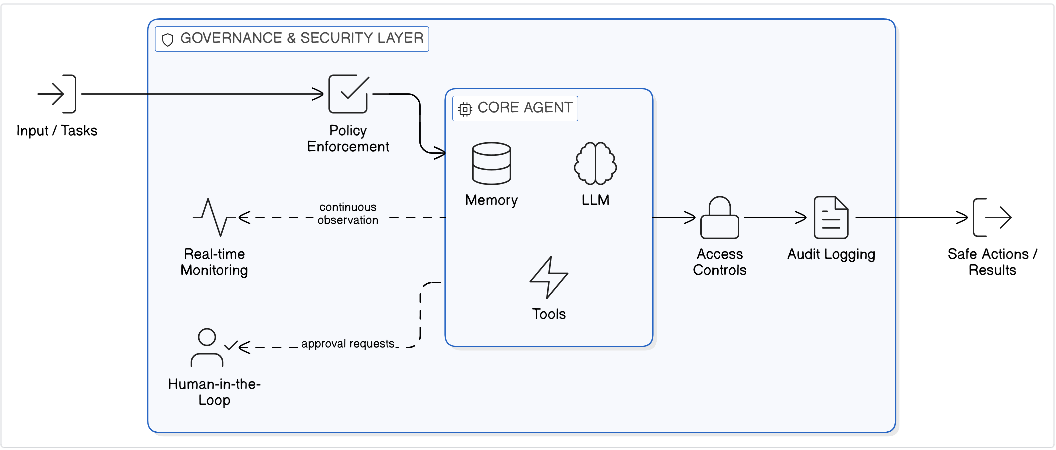
The autonomy of agentic AI opens the attack surface: agents obtain access to tools, make decisions, and take actions across systems. Weak governance is killing projects in 2026. Only ~14% of agentic deployments have complete security/IT acceptance, and 48% of cybersecurity experts include agentic AI as the most significant threat vector.
Important changes:
- OWASP Top 10 Agentic Applications (2026 edition) identifies risks like prompt injection, tool abuse, identity sprawl, and multi-agent escalation.
- Frameworks such as NIST AI RMF, CSA AICM, and Singaporean IMDA policies focus on policy, observability, enforcement, human-in-the-loop, runtime monitoring, and "governance-as-code."
- "Governor agents" high-integrity overseers that qualify worker agents in real-time are emerging.
Why it is important: In the absence of good guardrails, costs will run out of control, compliance will fail, and trust will be lost. Leading organizations are going governance-first otherwise, 40%+ of initiatives fail.
3. Adaptive Agentic Systems & Self-Improving Systems
With agents other than the static, we are seeing dynamic self-enhancing means: reflection loops, learning to reinforce rewards, meta-adaptors that optimize their own prompts/methods, and workflow systems that dynamically evolve. Agents can find bottlenecks, redesign processes, establish feedback loops, and improve performance without continuous human training.
Bridging research and production: Advanced reflection in labs applies to finance or operations agents with adjustment strategies based on actual outcomes.
Challenges: Hallucination risk, cost of iteration, evaluation challenge, etc., still exist, but 2026 will mark the shift from fixed agents to continuously adaptive agents.
Incentive: Lower maintenance, compounding ROI, and systems that become smarter.
4. Task-Specific Natively Implemented Agents in Enterprise Software
Machine agentic AI is already embedded inside CRM, ERP, cloud, and security packages, turning into aggressive decision engines in constrained areas.
Examples:
- Cloud cost optimization agents automatically scale resources.
- Security agents remedy incidents.
- Finance agents handle reconciliation.
Change: Replacing the availability of copilots with guardrailed autonomous executors. By 2026, many predict 33%+ agentic capabilities will be embedded in enterprise apps. This native embedding drives natural adoption and quantifiable ROI in limited, high-value work.
5. Democratization Day-to-Day Users as Agent-Builders
Low-code/no-code platforms allow business users to build agents. Marketers and ops teams can plan workflows without coding. Super-agent dashboards enable non-devs to design and deploy agents.
Impact in SMBs across APAC, GCC, and similar markets: Localized agents target local teams. Open models are used to comply, service customers, or manage BFSI processes.
Implication: Increase in agent volume, but also a need for governance.
6. Physical and Hybrid Worlds of Agentic AI
Multimodal agents combine vision, robotics, and edge computing to act in the real world.
First victories:
- Manufacturing: predictive maintenance + robot execution.
- Logistics: autonomous delivery to patients.
- Healthcare: on-site assistants to patients.
Embodied future: Physical AI agents perceive the world, behave safely, and adapt. Pilots in 2026 operate in industrial environments combining digital and physical processes.
7. Standardizing Protocols & The New Agent Internet
Silos will break as interoperability protocols (MCP, A2A) allow communication between agents across vendors and organizations. Agents work in ecosystems negotiating cross-company contracts or providing expertise securely.
Vision: An open agent internet accelerates swarms of multi-vendor and composable intelligence. Standardization drives geometric growth in complex cross-boundary use cases.
2026 Challenges and Reality Check
Obstacles:
- Cost increase and scaling resistance.
- Legacy systems preventing execution.
- Cancellations caused by governance gaps.
Success playbook: Phase rollouts, use bounded domains, start governance-first, monitor ROI tightly, and emphasize orchestration + security.
Conclusion & What to Do Next
2026 lays the groundwork of the agentic decade: multi-agent orchestration as architecture, authority as survival, self-enhancement as advantage.
For developers, IT leaders, and businesses (especially BFSI, IT, and GCC sectors globally):
- Triumph with LangGraph/CrewAI on multi-agent prototypes.
- Include governance early: observability, policies, human control.
- Start with limited high-ROI use cases.
- Track future interoperability protocols.